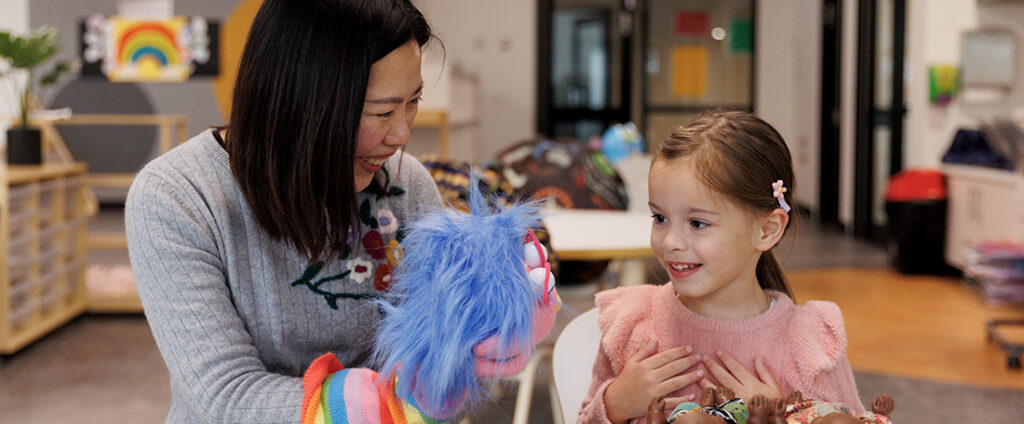
Parents are a child’s first and best educator. As a parent, you hold expert knowledge in who your child is and how they learn best.
But building strong bonds with children doesn’t always happen by accident. There are lots of things you can do as parents to engage deeply with your child at the right times in their development, having the biggest impact on both your parent child relationship, and their learning and development in the future.
Why play matters in parent-child relationships
For children, play is the main way they interact with, and contribute to, their world. Through play, children experience emotions, have ideas, think through problems and build on their developing knowledge of how the world works. It’s a time where children are mentally laying a foundation of understanding what relationships are and their purpose- foundations that will pave the way for future connections. During this time, children will look to the adults around them for cues on how to interact.
For parents, tuning into, and participating in, children’s play during their early years is a wonderful way to help children experience meaningful connections and positive relationships from a young age.
Different types of play that strengthen family bonds
Different types of play can help support both your child’s learning and development, and a healthy parent child relationship.
Imaginative play
Sometimes called make-believe or pretend play, imaginative play involves using toys, objects or costumes to support storytelling. Imaginative play can be an enticing way to engage your child in play with you. For example, using a block as a phone to dial and call your child (and offering them a block as a phone to answer your call) is a playful way to pretend together. Through imaginative play, children explore the emotions of others and make up stories or reenact activities that they regularly experience. It’s also a good time for your child to express empathy and start to use more language in their play.
Here are some other ideas for pretend play:
- Play kitchens or home corner using play food, or boxes from the recycle bin
- Make a cubby and pretend you’re going camping
- Role Swap – pretending you’re the child and they are the adult, and reenact a regular routine like getting ready for bed
Active play
Being active together is an excellent way to spent time with your child and build a good parent child relationship. It’s also great for your child to see you being active, healthy and moving your body in play. Active play can be as simple as:
- Kicking or throwing a ball together
- Ride a bike or take a walk
- Practice running, jumping or skipping
- Play a game with rules, like basketball
- Climb on the playground together
- Play on the swings, tumbling and roll to support your child’s proprioception and sense of body in space
Real world play
Real world play might look like changing a toy’s nappy together, washing a baby doll in the bath or sweeping the floors to tidy up the kitchen. Remember that shared play doesn’t need to be complicated or involve flashy toys – more often than not your child will want to replicate things you and your family engage in daily.
Creative and Sensory Play
Most children love arts and crafts, and it can feel really special when a grown up sits down to play too. Arts and Crafts play often feels very exciting for children – there’s usually toys and resources on offer that aren’t available all the time.
When creating together, be mindful not to ‘do’ things for your child, like draw the butterfly or cut the flower out. Instead, remember that arts and crafts are an important place where you can support your child to take age-appropriate risks and have a go at some new skills. Cutting with scissors, for example, is an activity that needs lots of adult support alongside the child in the beginning but can only actually be learned through practice and your child doing it themselves.
This play might look like:
- Construction play – using masking tape and empty boxes to make a fort
- Playing playdough or clay
- Painting
- Drawing
- Water Play
- Cutting with Scissors
- Using glitter and glue
Simple ways to incorporate more play into daily life
Play is where children learn, but sometimes life can feel too busy to be able to just play! Luckily, children can find play experiences in almost every part of daily life. Taking some time to find more spaces in the day where you can connect with your child during play, even if you are completing other necessary tasks, can be transformational for your relationship with your child.
Making time for play
It can be tricky to prioritise play among the competing priorities of everyday life. Thankfully, children don’t need huge periods of highly engaged play to build strong connections with you; some research suggests even 10 minutes a day of present, uninterrupted play is enough to create the trusting bonds that matter for relationship building.
Alternatively, you might find there are parts of your daily routine where you could inject a little extra playfulness with your child to help connect in small bursts across the day. Singing while in the car, playing action games while getting dressed or playing pretend by putting on lots of pairs of shoes are all ways to inject more friendly, positive play into children’s daily routines. These moments can turn what could otherwise be a dull routine into a treasured ritual for both you and your child.
Everyday tasks as play opportunities
You might have already noticed your child loves helping around the house. What you might not have realised is what a rich learning moment this can be for your child.
Housework
Children are always watching what you are up to around the house, and inviting them into these daily tasks can be really empowering (while still allowing you to get your tasks done!). Try:
- Folding the washing together
- Sharing the work by having two dusters, or
- Ask your child to be ‘in charge of’ the dustpan and brush as you sweep the floor
Experiences like this not only show children that they are capable and helpful, but overtime, instil a shared responsibility and joy of looking after things.
Mealtimes
Preparing meals is another daily event that children can find incredibly exciting to be a part of. Whether simply:
- watching what you’re doing and listening to you talk about what you’re making
- helping out with a spoon to mix a batter, or
- using a measuring cup to prepare the ingredients
Children who can join you in the ‘play’ of preparing meals get some time watching and noticing how you care for them, and yourself, through food and nutrition.
Following your child’s lead
It’s important to notice what your child is interested in to make the most of play opportunities together. Remember that playfulness cannot be forced, and play together will always be more successful and enjoyable if you firstly notice what your child is interested in, and then extend on their interest by getting curious about it too.
- If your child loves trains, laying on your belly and making a train track yourself will be the ultimate invitation to play for your child
- If your child loves taking the Tupperware out of your kitchen cabinet, build on this interest by working together to help each container find its lid
- If your child loves singing, making up your own silly song while you go about your day will captivate your child, show them your playful side and inspire them to create a song or two of their own!
Age-appropriate play ideas for stronger connections
Here are some ideas for age-appropriate ways you might engage in play with your child to build a stronger parent-child relationship. Of course, these are just a few, and there are many more too! Once you get started, it will be easier to see just how many opportunities there are to meaningfully engage and build bonds with your child across the day.
The important thing for relationship building is how present you are when you are with your child. For the list below, even the simplest play moments can become rich moments of connection – you just need to be present, engaged and curious.
Babies and Toddlers
- Play peek a boo – games like this encourage eye-contact, give children your undivided attention and help with the concept of object-permanence
- Lay on your belly or side and play on the floor alongside your baby
- Go out for a walk and talk about all the things you can see
- Read books together
- Smile, talk, sing and make funny faces
- Play with textures and colours together. Crunch autumn leaves or notice the changing leaves
- Speak in different, silly voices
- Play music and dance together
- Play at the playground or at playgroup together
Preschoolers
- Read books together
- Retell well known stories to each other, or make up your own new stories
- Tell jokes and laugh a lot
- Play dress ups
- Pretend play like home corner or doctors
- Trains, cars and character play
- Clean up the house or do other household jobs
- ‘Read’ the shopping list together when buying the groceries
- Draw or paint together
- Introduce games with rules and turn-taking, like bingo or snap
- Feed the dog or cat
School-Aged Children
- Write a shopping list together, and cross things off the list as you put them in the trolley
- Play games with rules like Monopoly or Snakes and Ladders
- Play ball games like footy, basketball, soccer or tennis
- Learn to skip or make a hopscotch
- Cook together in the kitchen
- Make an obstacle course inside with couch cushions
- Pretend play with the characters your child knows and loves best
- Read books, or have your child read to you
- Listen to music – or record some of your own!
Common challenges parents face and how to overcome them
Phones – It is so easy for busy parents to be pulled out of play and back into the business of life if your phone happens to ring while you’re playing. Try putting your phone in another room for ten minutes so you can practice being fully involved in the play.
Screen Time – Although there are many schools of thought around the use of screens, we recommend you don’t use screentime as the tool to connect and build on your relationship with your child – there are just too many non-screen moments that could be used instead!
Screens tend to pull children’s attention, which means they’ll see less of you during the play. We also tend to talk to each other less when a screen is around, meaning your child might be missing out on extra time chatting with and listening to you. Try popping the screen away and out of sight while you engage in rich pretend play with your child.
Child Resistance – Remember that playing is children’s work, and sometimes it can be too demanding, tricky, overwhelming or not interesting. Do your best to read your child’s cues for when they’ve had enough playtime with you. Don’t forget the importance of following your child’s lead on what to play – as adults it can be very easy to accidentally dominate the decision making! Let your child be the decider of the play, and build from there.
How Play Supports Long-Term Child Development
Play is the primary way your child learns. When your child plays with you, they are learning important social cues and beginning to see how emotions can contribute to or detract from an interaction. Through play, your child practices thinking in new ways, understanding problems and finding solutions. And perhaps most importantly, through play, your child learns to find joy and seek out the things they like in our world – a vital skill for being a connected and curious learner both now and as they develop.
Creating a play-friendly home environment
Playful spaces give children the best start to a life of learning and play. You can support your child at home by trying the following things:
Observe the space – taking a ‘child’s eye view’ of the rooms in your house and notice what your child can see, reach and play with.
Let your child choose the play – double check the toys and resources you want your child to use are visible and within reach so they can make their own choices (and the things you don’t want touched are out of reach!)
Less is more. Sometimes it can be overwhelming to see every toy at once. Try placing 5-6 toys on offer and storing the rest away. Then, reset new toys across the day to keep things fresh and engaging.
Keep it simple. Remember, children don’t need lots of flashy toys to play and learn. Think of keeping a dustpan and brush, a box of Tupperware, or some of your kitchen utensils handy to spark your child’s creativity and encourage some pretend play across the day.
Make sure there’s room to move – Active play is important for your child, both outdoors and indoors (if possible). See if you can create a space where tumbling is allowed, maybe on a cushy rug or the couch.
Small, or quiet spaces – Children love a nook or a quiet space to play. Place books or soft toys, sensory toys or cuddly blankets to help your child regulate their own emotions and engage in this oh-so-important slow play.
Quality matters more than quantity
A little goes a long way when comes to showing your child you are interested in being a part of their play world. A couple of minutes a day of fully present play with them and their toys, or a couple of minutes of inviting them to play alongside you as you go about your day, really adds up overtime.
Expert Insights from Early Learning Specialists
When children spend quality time with trusting and attuned adults, they experience the benefits of reciprocity and connection that can set the tone for the types of relationships they will come to have across their lifetime. It matters that much.”
Julia Gray, Professional Learning and Development Manager, Uniting Early Learning
Nurturing and responsive relationships build healthy brain architecture, providing a strong foundation for children’s learning, behaviour and health. The relationship a child has with their caregivers literally sculpts their brain and determines the development of brain circuits.”
Professor Frank Oberklaid AM
FAQs
How can I improve my parent child relationship?
Children notice and value when their grown-ups are being present with them. Start small and find ten minutes a day to give your child some undivided attention in play.
What are the signs of a healthy parent child relationship?
There a lots of ways children engage with the adults in their life, and this can look different for each child. It also depends on the age of your child. But generally, when children feel connected to their grown-ups, they will typically seek to engage their adults in play, or show interest in what you are doing and want to be involved. Taking an interest in you, and noticing what you are up to, is a key sign your child is connected to you and interested in spending more time with you.
How can I build a good relationship with my child?
Play with your child and invite your child to play with you as you go about your day to day. This article provides lots of practical examples of what this might look like for you at home.
What activities strengthen a parent child bond?
Sharing in your child’s interests and showing your child what you are interested in is a great way to strengthen the parent-child bond. Being kind, loving and playful also helps. Spending time in play with your child and not only interacting to give an instruction or to get through a routine, helps to build connection.
Why is play important for my relationship with my child?
Your child’s primary way of learning about and understanding their world is through play. In some ways, play is the only way to truly build a strong relationship with your child. Children need to see and feel that their grown-ups are playful and interested in them in order to open up and connect. As adults, when we take the time to pause our busy days and simply ‘be’ with children in play, we too get to reap the rewards of a shared, trusting relationship in play with our child.